Dubai stands out in the world as almost a singular example of a city with a unique demographic distribution, with more than 85% of its population consisting of expatriates. Have you ever asked yourself what the answer is to the question of what nationalities are the most common in Dubai? The answer is not a single figure or one single country. It is the collection of several nationalities that contribute and play an important role in the city’s economy, culture, and way of life. In this Dxboffplan article, we analyze the most populous nationalities in Dubai, the reasons for their presence, the demographic changes, and what effects the large number of nationalities have.
Key Points or this article:
85% of the population in Dubai are foreigners and immigrants.
Pakistani and Bangladeshi workers in Dubai work in the operational and service workforce supporting Dubai.
The tourism, healthcare, and customer service industries are largely reliant on the services of Filipinos.
Iranians are one of Dubai’s oldest immigrant communities, with a strong presence in trade and real estate.
Only about 10% or less of Dubai’s residents are Emirati citizens.
English is the dominant means of communication among Dubai’s citizens in both professional and social settings.
Dubai is among the most welcoming cities to immigrants.
Dubai; a Multinational City with a Population Beyond its Natives
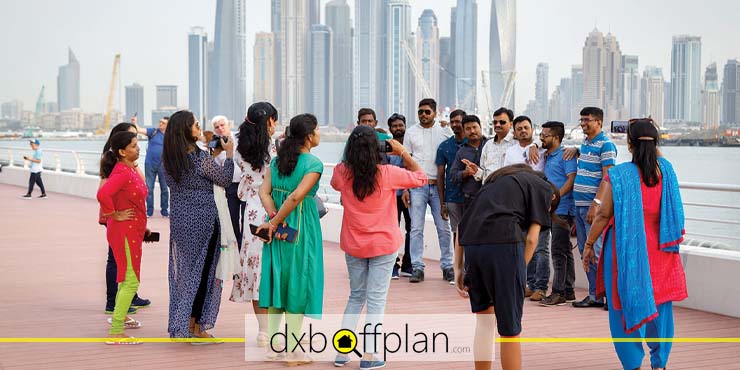
Unlike other cities in the world Dubai stands out for its particularly low number of native population. The natives here form a tiny fraction of the overall number as 90% of the residents have immigrated to Dubai. The immigrants come from Asia, Europe, Africa and other Arab worlds; they are active in different sectors and contribute to the city’s progress and economical success.
There is a vast range of opportunities in the United Arab Emirates that attracts immigrants no matter where they come from hoping for a better life and job prospects. Although other cities in the United Arab Emirates offer great opportunities, it is Dubai that offers the most diverse population and best economical incentives. This is evidenced by the diverse opportunities created in the construction, service, and managerial support of foreign investments and technology.
The world’s largest destination for labor migration has become Dubai, a city with job openings across nationalities and socio-economic classes. Many immigrants see Dubai as the best city in the Arab world to live and work. The large immigrant population has radically altered how people in the city interact compared to other cities in the region.
What is Dubai’s Demographic Composition like?
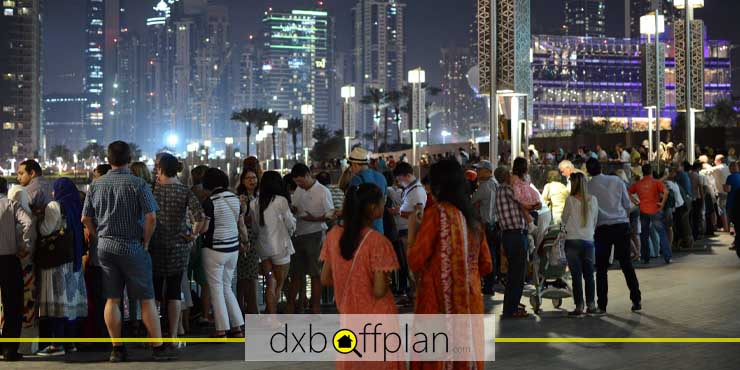
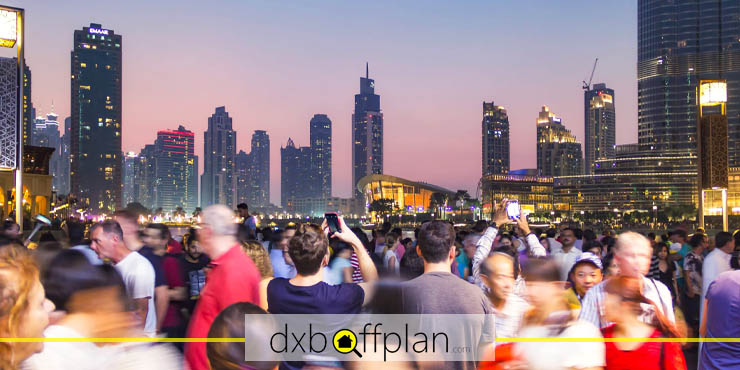
Dubai has the most multilingual and multicultural population in the region. English, Arabic and even Hindi, Persian and French and Chinese are commonly spoken in shops, schools, neighborhoods and even in the food courts in the malls. This diversity makes Dubai a true cosmopolitan; a city that is beyond just a trade and tourist destination. Dubai is amongst the rare cities having such a distinctive demographic structure which is beyond the population patterns typical for most cities and even countries.
It may seem easy to assume that all cities in the UAE have a highly Emirati dominant and controlled labor force, but that is not the case in Dubai. The situation is less simple. Most of the workforce in Dubai is made up of foreigners, which makes the city one of the largest centers of labor migration in the world. The situation with laborers is unique in that opportunities are made available to all social classes and nationalities. Additionally, many expatriates consider the UAE the best country in the Arab world to move to for employment.
As the population is diverse as it gets, the social standards and structure of Dubai is naturally very different from the other cities in the UAE or Arab world. You may be walking down the street and hear people talk in English, Arabic, Hindi, Urdu, Persian, and even French and Chinese. The restaurants, shops and other entities of the same experience as well here you get to enjoy an exceptional multicultural environment that you wouldn’t easily find in other big cities in the world.
How Diverse is Dubai’s Demographic Composition?
Dubai has one of the world most interesting demographic compositions and note worthy fact is that the immigrants do not belong to a particular social class or a job category there is a clear diversity in the population and they include unskilled laborers, going all the way up to senior executives of foreign companies or medical specialists. Here’s a thorough look at the ~3.8–3.9 million population of Dubai and its Demographic Composition in 2024–2025:
Category
Group
Estimated Share of Population
Notes
Nationality status
Emirati citizens
~7–8%
Native UAE citizens are a small minority
Expatriates (non-Emiratis)
~92–93%
One of the highest expat shares globally
Largest nationality groups
Indians
~30–38%
Largest single nationality
Pakistanis
~16–17%
Second largest group
Bangladeshis
~7–9%
Major labor force segment
Filipinos
~6–7%
Strong presence in services and healthcare
Arab expatriates (various countries)
~20–25% combined
Includes Egyptians, Jordanians, Syrians, etc.
Western / European residents
~10–15% combined
Professionals and business sector
Other nationalities
Remaining share
Residents from 200+ countries
Gender distribution
Male
~68–69%
Due to migrant workforce patterns
Female
~31–32%
—
What Attracts Immigrants to Dubai?
The reason behind immigrants’ attraction to Dubai could be explored on many levels. The reason behind this phenomenon is Dubai’s economical, social and legal openness and transparency. Here’s a more detailed look on nationalities in Dubai:
The construction, trade, tourism, technology, finance, and service sectors offer broad and varied employment prospects.
The income earned by migrants is tax-free, and salaries can be saved for further financial advancement.
Compared to most major global metropolitan areas, there is a greater degree of both social and economic safety and security.
There is also excellent modern infrastructure, including advanced systems in transportation, the internet, health care, and education.
There are a variety of flexible and different residency rules, including working visas, Golden Visas, freelance visas, and residency through investment.
Considering all of the above, Dubai has become a place of serious consideration, not just for migrant workers, but also for professionals, entrepreneurs, and families who are interested in improved living standards and more secure prospects. This helps answer the question of which nationalities in Dubai are the most common.
The Most Common Nationalities Living in Dubai
Dubai accommodates communities of high significance in terms of both the numbers and the economic and social functions. In the following paragraphs, we review the most significant and most populous nationalities in Dubai:
Indians; the Largest Immigrant Community in Dubai
Indians are a huge population in Dubai that comprises 30 to 35 percent of the town’s entire population. Their community has been a strong one over the past several decades with great contributions to the economy of Dubai. The Indian community has chosen immigration for the satisfactory and high standard living conditions in UAE. Here are some of the reasons that the Indian community is the largest man in Dubai:
Trade and economic relations between UAE and India
Presence at all levels of employment, from unskilled laborers and technicians to managerial positions, doctors and business owners
Old and extensive community with robust support systems
Strong work presence in trade, IT, construction, retail and services
Pakistanis; an Essential Workforce in Dubai
Pakistanis are among the largest immigrant nationalities in Dubai, and typically rank second or third in population size. This community is instrumental in the supply of operational and skilled workforce in Dubai. A large number of them are active in:
Construction and technical workers
Drivers in both public and private transport
Urban support and services
This group covers a large part of the operational workforce in the city
Bangladeshis and Their Contribution to Dubai’s Economy
Another large nationalities in Dubai are Bangladeshis and they are economically important to the city. Almost all of them are in blue-collar and service jobs and constitute the majority of Dubai’s basic workforce. That is why this group is considered one of the foundations of the workforce in Dubai. Here is the scope of Bangladeshis and Their Contribution to ’s Economy:
Strong presence in construction and infrastructure projects.
Key workforce in cleaning and maintenance services.
Major role in manufacturing and industrial labor.
Essential support in logistics and warehouse operations.
Employment in retail and small business sectors.
Significant contribution to urban development projects.
Filipinos; Involvement in Services and Tourism
Filipinos are in a unique position in the labor market in Dubai and the majority of them are involved in service and frontend jobs. Their number is also large in the tourism and health services sectors. This community’s strong points are their fluency in English work discipline and communication skills. The main fields of work of the Filipinos are:
Hospitality and Tourism
Restaurants and Cafes
Health and Medical Services
Domestic and Care Giving Services
Iranians in Dubai; Position and Number
Iranians are among the oldest and most established groups of immigrants in Dubai. Current estimates of the Iranian population in Dubai, both officially and unofficially, range between 400,000 and 600,000. The Iranian community mainly lives and economically operates in the areas of Deira, Jumeirah and Business Bay.
The Iranian community has established an interrelated system in the activity places and initiates such as trade and commerce, real estate and investment, food and restaurant services, and technical and professional services, thus constituting a considerable share of the private sector in Dubai. Because of a more significant presence by Iranians in trade, real estate, and the service sector, the living conditions in Dubai compared to many other immigrant groups have been more socially, economically, and functionally integrated for Iranians. Iranians in Dubai Dubai have a considerable share of Britons and Europeans. Although in terms of numbers, the representation of citizens of the UK, France, Germany, and other European countries is minimal, the impact is significant. Because of the shared language and culture, they constitute a large part of the population. Here are the groups characteristics:
Work mainly in management, design, investment, and professional roles.
Typically have higher incomes and affluent lifestyles.
Common fields: media, education, consultancy, and management.
Increasing Ethnicities in Dubai
Recently, in addition to conventional and highly populated ethnicities, some immigrant groups have received considerable attention in Dubai. The migrant community in the African region, more specifically, Nigerians, Kenyans, and South Africans, is becoming more prominent in the city and diversifying their developments in trade and services and in startups.
Additionally, migrants from the Eastern parts of Asia have been claiming a larger portion of the population in Dubai. Increased nationals from China, South Korea, and Japan have been more dominant in the economic and demographic composition of Dubai by investing, fostering trade relationships, and occupying roles in the modern economy and high technologies.
Diversity of Nationalities in Dubai and its Influence on the Economic and Social Framework
The high degree of ethnicities in Dubai has significantly influenced the culture, way of life, and social fabric of the city. Immigrants have created an environment where English is the dominant language of communication at workplaces, trade, and at day-to-day social interactions, while Arabic is the designated national language of the United Arab Emirates. Apart from these two languages, dialects like Hindi, Urdu, Persian, and Tagalog have become commonplace in the communities, commerce, and at work. This multilingualism have had its effect on Dubai’s labor market as well. The diversity has helped with the job competition, expanded services, and effected positively on the growth of startups. That is why Dubai is one of the most dynamic cities in the world when it comes to economic activity and modern lifestyle. Here’s the Major Nationalities present in Dubai and their usual economic roles:
Nationality / Group
Key Economic Role
Typical Sectors
Contribution to Economy
Indians
Diverse workforce
Trade, IT, retail, construction, healthcare
Business activity and investment
Pakistanis
Operational workforce
Construction, transport, technical work
Urban infrastructure support
Bangladeshis
Labor and service workforce
Cleaning, maintenance, services
Essential city operations
Filipinos
Service professionals
Tourism, hospitality, healthcare
Customer-facing industries
Iranians
Trade and investment
Real estate, commerce, restaurants
Private sector development
Europeans / Westerners
Professional and executive roles
Management, education, consultancy
Knowledge economy growth
Final Words
Dubai is one of the best examples you could find of a multinational environment and the positive effect it can have on society and its progress. Most of the population here are immigrants and native people make up 15% of the population. Recent data shows that the majority of the population living in Dubai are Indians and after them are the Pakistanis, Bangladeshis, Filipinos, and Iranians. Alongside them Europeans and other Arabic speakers also live in the city and work in different sectors like economy and management. The town’s labor market has been shaped by the diversity of nationalities in Dubai leading it into the most successful cultural and economical scenes in the world. Dubai is one of the most immigrant friendly cities in the world where the opportunities for finding a better life are perhaps endless. If such circumstances are tempting to you and you could see yourself living here and engaging in a successful career or investing in business or real estate, we invite you to contact us today at Dxboffplan. In order to start your life here you need a place to live and the place must align with your life science expectations and family requirements. Our team, with years of experience in Dubai’s real estate will find you the perfect property that is both in your budget range and offers an enhancement to your lifestyle. We would also explain to you the latest changes in Dubai real estate prices, residency options and help you make a confident, well informed decision.
frequently asked questions
The largest number belongs to Indians living in Dubai and they make up 30% of the city's population. They work in all kinds of job levels whether it is labor and technical work all the way up to business ownership and more.
They only make 15% of the town's population as the majority or foreign expats coming from Asia, Europe, Africa and other countries.
The Iranian population in Dubai is around 400,000 and 600,000. That number counts both official and unofficial residence Iranians or among the oldest immigrants in Dubai and are usually active in Real Estate and trade.
In this town you get to experience tax-free income, a whole range of job opportunities, great safety and highest expectations of infrastructure. The town also offers residency options for those special talents or those who have the means to invest in real estate or business. These are all highly tempting options for those willing to work or invest and settle in with their family.
Dubai is a multi-lingual and multicultural City offering an inviting environment to all expats no matter where they come from. Diversity has impacted economic progress, expansion of services and innovation.
The real estate market in Dubai has witnessed one of the fastest trends in market growth within the region in recent times. Within this market, under-construction properties, commonly called off-plan properties, have been at the heart of property transactions and have been instrumental in drawing both domestic and foreign investors into the market. As per […]
The Dubai real estate market has witnessed unprecedented growth in the past few years. Increasing property prices, record-breaking sales, and the constant launch of new projects have raised an important question in the minds of many potential buyers: Have the best investment opportunities in Dubai already passed? According to Mario Volpi, Senior Investment Advisory at […]